
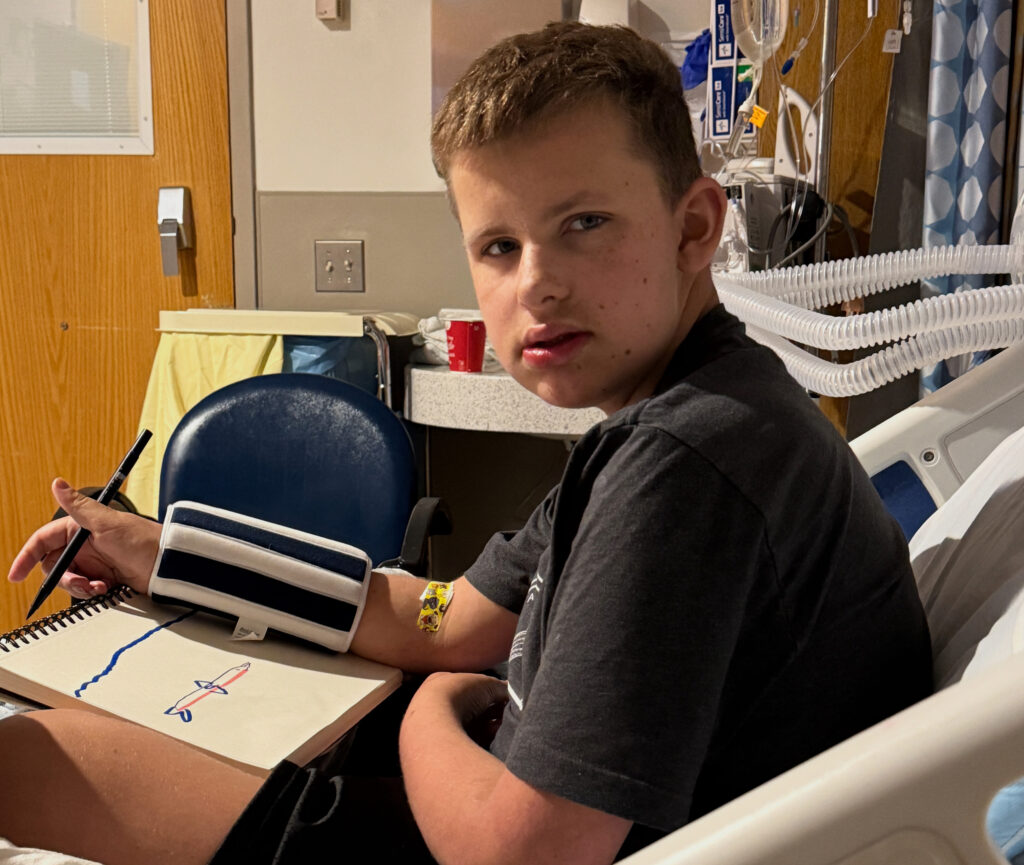
Recognizing hypothalamic syndrome offers new hope for understanding, preventing, and treating the complex challenges faced by survivors like my son.
As I sit to write this, I’m closing out what has been one of the most challenging years in a decade-long journey with my son, Alex, a craniopharyngioma survivor.
It’s been ten years since his diagnosis and resection surgery, and while we are grateful every day that he is still with us, this year has tested us in ways I never imagined. We’ve faced constant illness, new diagnoses, inconclusive test after inconclusive test, four emergency helicopter rides, and what felt like a permanent presence inside the walls of Children’s Hospital of Philadelphia.
Alex has always been what you might call a “complex case.” And as he grows older, those complexities don’t fade. They multiply.
In my role as executive director of the Raymond A. Wood Foundation, I’ve had the privilege and the heartbreak of seeing the full spectrum of experiences among survivors of hypothalamic-pituitary brain tumors like craniopharyngioma. I’ve seen patients go through treatment and go on to lead fulfilling lives, requiring only manageable levels of hormone replacement and follow-up care. And I’ve seen others, like my son, face devastating, lifelong consequences.
It’s the latter group that motivated me to start this foundation. And for so long, I didn’t have the right words to describe what was really happening to these children and families. Yes, Alex is a craniopharyngioma survivor. But the tumor is long gone. What remains and what we live with every day has not had an adequate name.
Until now.
This year, there’s been a meaningful shift in how researchers and clinicians are talking about what we experience. They’re calling it hypothalamic syndrome. And for me, as a caregiver, a parent, and an advocate, that changes everything.
Hypothalamic syndrome finally puts a name to the constellation of challenges that have dominated our lives since Alex’s surgery. It includes:
- Adipsic arginine vasopressin deficiency (what some still call adipsic diabetes insipidus)
- Debilitating fatigue
- Temperature dysregulation
- Cognitive impairments
- Sleep disruption
- Mood instability and memory loss
- And the more visible and talked about symptoms like hyperphagia, obesity, and metabolic dysfunction
For too long, the focus has been almost exclusively on hypothalamic obesity, as if that one symptom could fully explain or define the experience. But now, researchers are seeing the full picture. These symptoms don’t exist in isolation. They’re part of a syndrome, one that affects multiple systems in the body, and one that demands a more holistic, patient-centered approach to treatment and research.
This reframing opens the door to different conversations. Conversations about root causes, not just symptom management. It allows for broader-spectrum research that reflects the full lived experience of those affected. It creates space for new therapies and technologies that go beyond weight control to support cognitive function, emotional health, and quality of life.
And most importantly, it gives families like mine the language to describe what we’ve been facing for years.
For newly diagnosed families, I want to say this: yes, there are good outcomes. Craniopharyngioma is often labeled “benign,” and while that may be technically true from a cancer classification standpoint, benign is a meaningless word when it comes to the brain. Outcomes vary widely, and they depend on so many factors: tumor size and structure, proximity to the hypothalamus or pituitary, the age of the patient, the experience of the surgical team, and the treatment approach.
If I could go back to the day Alex was rushed into emergency surgery, I would have begged the surgeons to do everything possible to spare the hypothalamus.
This tiny structure is the command center for nearly every essential function in the body. We still don’t fully understand all that it does, but I live with the consequences of its damage every single day. I urge parents and caregivers to advocate fiercely for surgical approaches that reduce the risk of hypothalamic injury. Ask the hard questions. Bring this up, even if your medical team doesn’t.
I’ll admit, hope doesn’t come easily to me anymore. Too often, it’s been followed by setbacks, unanswered questions, or the painful realization that progress is slow. More often than not, hope has felt like a risk.
But as this year comes to a close, I’m starting to feel something I haven’t felt in a long time — a cautious but genuine sense of hope.
Hope that with a clearer diagnosis of hypothalamic syndrome, we can push for earlier recognition, better prevention, and more comprehensive care. Hope that we can equip researchers, clinicians, and industry partners with the insight they need to build real solutions. Hope that the next generation of survivors will have not just more years, but better ones.
We’re finally finding the words. And with them, we can build a path toward better outcomes.
—
Amy Wood
Executive Director
Raymond A. Wood Foundation