
How registry data is turning patient experience into evidence
For people living with the long-term effects of craniopharyngioma, fatigue can be much more than simply feeling tired. It can affect the ability to work, attend school, participate in family life, stay active, and complete everyday tasks.
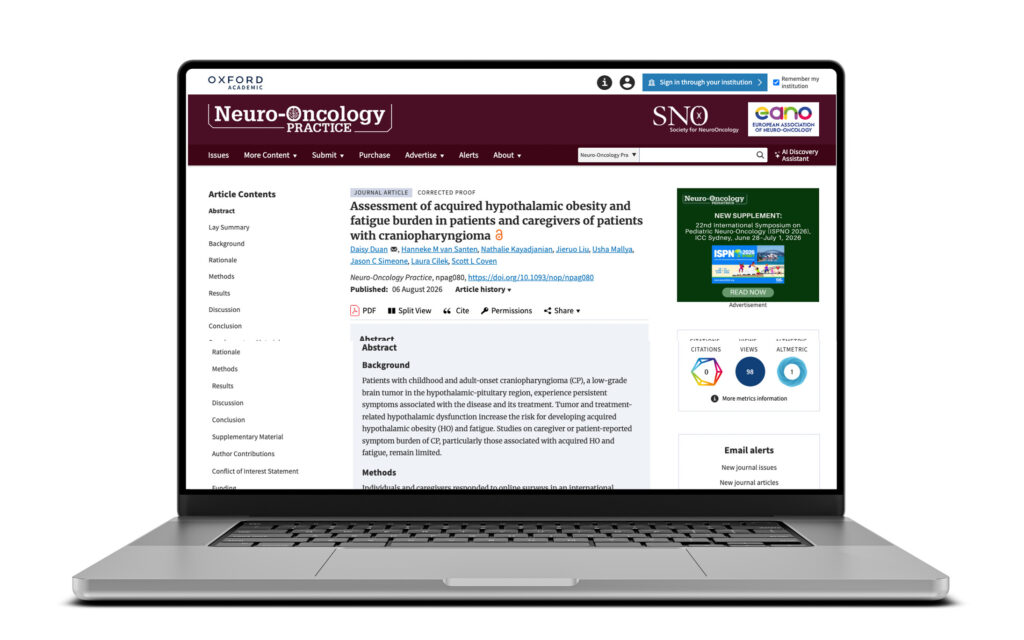
A newly published study in Neuro-Oncology Practice helps put data behind what many survivors and caregivers have been describing for years: fatigue and excessive daytime sleepiness are common, persistent, and often difficult to treat after craniopharyngioma. The burden for CP survivors with acquired HO appears to be particularly significant for people who also develop acquired hypothalamic obesity. The study also shows that daily living activities are significantly more impacted in these individuals. Overall, most participants found strategies for management of fatigue ineffective.
Importantly, the research was made possible through the Raymond A. Wood Foundation (RAWF) Hypothalamic-Pituitary Brain Tumor Patient Registry, demonstrating how patients and caregivers can directly contribute to a better understanding of life after treatment.
Looking Beyond the Tumor
Craniopharyngioma is a rare brain tumor that develops near the hypothalamus and pituitary gland, two areas of the brain that regulate many essential functions.
Although craniopharyngiomas are considered low-grade tumors, their location means that both the tumor and its treatment can have lifelong consequences. Survivors may experience hormone deficiencies, changes in weight and metabolism, sleep problems, cognitive challenges, temperature regulation problems, vision impairment, and fatigue.
One particularly challenging condition is acquired hypothalamic obesity, often called HO. It can develop when the hypothalamus is damaged by the tumor or its treatment. Because the hypothalamus helps regulate hunger, fullness, energy expenditure, and other body functions, this damage can lead to rapid and persistent weight gain that is very different from common forms of obesity and can be difficult to treat.
The new study asked an important question: How do fatigue and sleepiness affect people with craniopharyngioma, and is that burden different for people with acquired hypothalamic obesity?
Patients and Caregivers Helped Provide the Answer
Researchers analyzed surveys completed by 103 patients with craniopharyngioma or their caregivers. Participants were part of RAWF’s Hypothalamic-Pituitary Brain Tumor Patient Registry, an international registry launched in 2024 to collect information directly from patients and caregivers.
The surveys examined symptoms, fatigue, daytime sleepiness, daily functioning, and experiences with treatments. Researchers also used established questionnaires designed to measure fatigue and excessive daytime sleepiness.
This patient and caregiver perspective matters. Traditional physical measures in the clinic can tell us a great deal about the tumor, the hormonal consequences and other physical measures, but they do not fully capture what it is to live with the consequences of hypothalamic-pituitary disease every day. For a more comprehensive understanding of the disease, it is essential to value and combine both the patient experiences with physical and other clinical data.
Fatigue Is Common, and Its Impact Is Significant
The findings were striking.
Overall, 72.8% of patients experienced fatigue. The study found substantial fatigue among people with craniopharyngioma regardless of whether they had been diagnosed with acquired hypothalamic obesity. But those with acquired HO experienced an even greater burden.
We previously showed that more than 70% of CP survivors experienced fatigue after CP treatment, and that fatigue represents one of the most impactful health challenges on the survivor’s day-to-day life or ability to achieve long-term goals. In addition, we showed that survivors diagnosed with HO were significantly more impacted by fatigue than those without HO.
In this study, adults with acquired HO reported greater overall fatigue, including significantly higher levels of general and mental fatigue. Patients with acquired HO also experienced greater daytime sleepiness and more difficulty with activities of daily living.
In fact, after researchers accounted for factors including age, sex, and whether the survey was completed by a patient or caregiver, people with acquired HO were 2.5 to 3.4 times more likely to experience certain impairments in daily activities and daytime functioning related to fatigue and sleepiness compared with those without acquired HO.
These findings reinforce an important point: fatigue after craniopharyngioma is not necessarily ordinary tiredness. For some survivors, it can be a significant part of the disease burden.
Fatigue Is Only One Part of a Complex Picture
The results of the study reinforce our previous findings showing how many health challenges survivors may be managing at the same time in addition to fatigue, especially for patients with acquired HO.
This complexity is important when thinking about the origin or management of fatigue. There may not be a single cause or a simple solution. Craniopharyngioma survivors can live with overlapping metabolic, hormonal, behavioral, and sleep-related conditions.
This research reinforces our previous findings showing that fatigue is a significant determinant of caregiver burden and impaired quality of life in CP survivors. Fatigue mostly impacts the survivor’s daily life and represents one the treatment priorities for craniopharyngioma survivors and their caregivers.
Current Approaches Are Not Working Well Enough
Perhaps one of the most important findings is how difficult fatigue has been to manage.
Patients and caregivers reported trying a variety of strategies, yet fewer than one-third found fatigue-management approaches effective. Participants also consistently identified managing fatigue as an important priority.
That gap between the burden of fatigue and the effectiveness of available options represents a significant unmet need.
The study does not establish a new treatment for fatigue, nor does it show that one particular intervention will work for every patient. Instead, it provides evidence that fatigue deserves greater recognition, research, and attention as part of long-term craniopharyngioma care.
Turning Lived Experience Into Evidence
For RAWF, this study also demonstrates why patient-driven research infrastructure matters.
The Hypothalamic-Pituitary Brain Tumor Patient Registry was created to build a central source of information about rare hypothalamic-pituitary tumors and the experiences of the people living with them. In this study, information contributed by patients and caregivers helped researchers quantify challenges that can otherwise be difficult to see in routine clinical data.
Every survey response represents lived experience transformed into data that researchers and clinicians can study.
That is especially important in a rare condition such as craniopharyngioma, where individual medical centers may see relatively few patients. Bringing patient and caregiver experiences together can help identify patterns, highlight unmet needs, and generate questions for future research.
A Collaboration Rooted in the RAWF Community
This research also reflects the collaboration at the heart of RAWF’s work. Several of the study’s authors have leadership and advisory roles with the foundation. Scott L. Coven, is a member of RAWF’s Board of Directors; Daisy Duan, serves on our Scientific Advisory Board; Hanneke M. van Santen serves on our Registry Advisory Board; and Nathalie Kayadjanian, PhD, is RAWF’s Scientific Director. Their collaboration, together with the patients and caregivers who contributed their experiences through the registry, demonstrates how bringing researchers, clinicians, advocates, and the patient community together can help turn lived experience into evidence that advances our understanding of hypothalamic-pituitary brain tumor survivorship.
What Comes Next
This study makes clear that surviving craniopharyngioma does not necessarily mean leaving its effects behind.
Fatigue, daytime sleepiness, hypothalamic obesity, and other long-term complications can continue for years after diagnosis and treatment. Recognizing those challenges is an important first step, but recognition alone is not enough.
More research is needed to understand why fatigue is so severe for some survivors, how hypothalamic dysfunction contributes to it, and which interventions can meaningfully improve energy, alertness, daily functioning, and quality of life.
For patients and caregivers who have felt that fatigue is an overlooked part of life after craniopharyngioma, this research provides something important: evidence that the burden is real, measurable, and worthy of greater clinical and scientific attention.
And it shows what can happen when the experiences of patients and caregivers become part of the research itself.
Join the Patient Registry Support Our WorkThis study was supported by funding from Rhythm Pharmaceuticals, which provided funding to RAWF for survey implementation, data collection, and participant compensation, and to GIPAM, Inc. for study analysis. Rhythm Pharmaceuticals reviewed the manuscript for medical accuracy, while final content and publication decisions remained with the study authors.