
When one small part of the brain affects many parts of life.
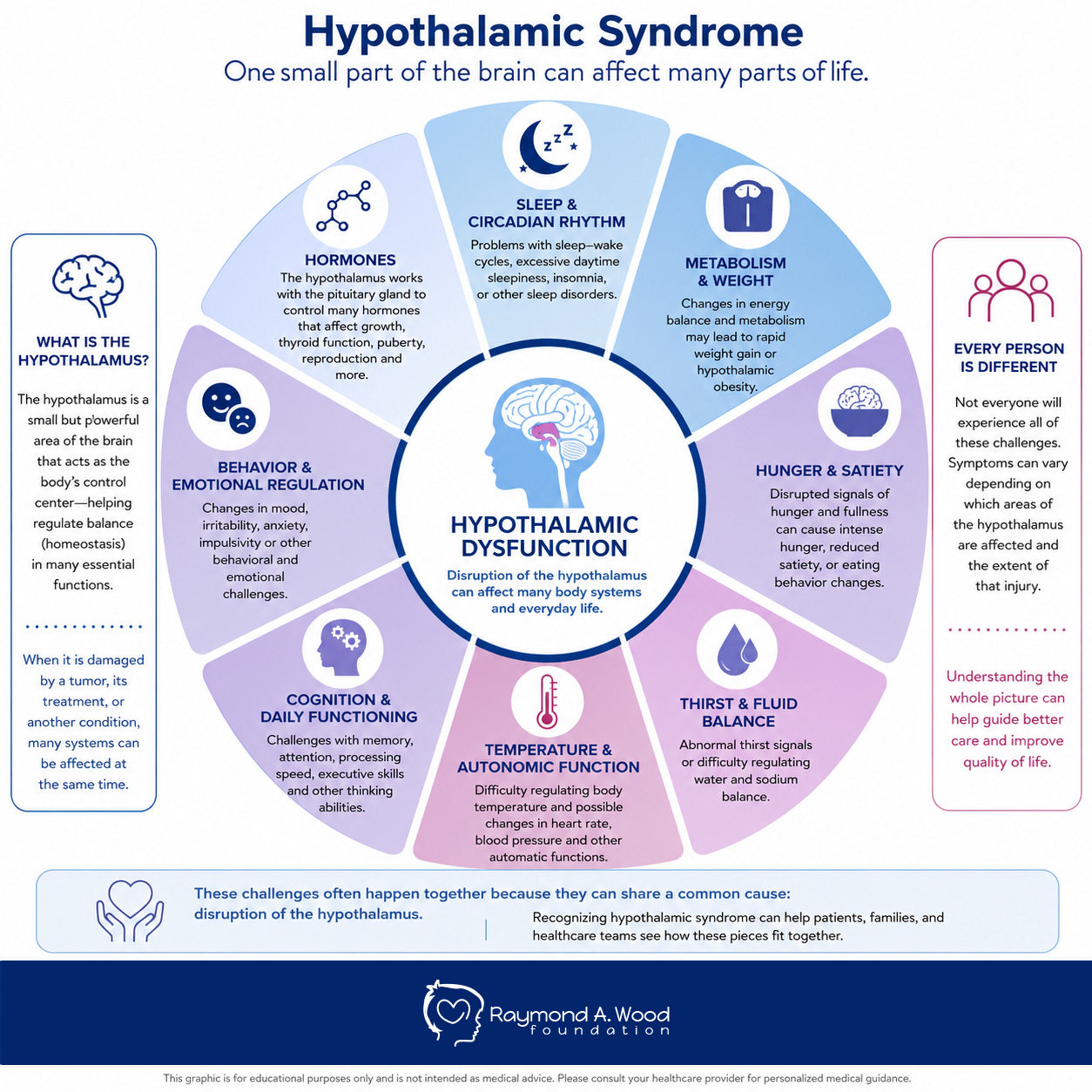
The hypothalamus is a small but powerful area of the brain, composed of several nuclei, that helps keep many of the body’s essential functions in balance. It plays a role in hunger and fullness, metabolism, sleep-wake cycles, body temperature, hormones, thirst and fluid balance, energy, cognition, behavior, and other functions that we rely on every day.
When the hypothalamus is damaged by a brain tumor, its treatment, or another medical condition, many of these systems can be disrupted at the same time.
This collection of symptoms and health challenges is increasingly described as hypothalamic syndrome.
For survivors and families, this concept can provide an important way of understanding the bigger picture: symptoms that may seem unrelated may actually be connected through hypothalamic dysfunction.
On this page
- What is hypothalamic syndrome?
- What does the hypothalamus do?
- What should I do if I recognize these symptoms?
- More than hypothalamic obesity
- Why hypothalamic syndrome occurs?
- Why recognizing hypothalamic syndrome matters
- An evolving area of medicine
- How RAWF is helping advance the science
- Research and further reading
What is hypothalamic syndrome?
Hypothalamic syndrome is a term used to describe a range of health problems that result when the hypothalamus is damaged or does not function normally.
A major scientific review published in Nature Reviews Disease Primers in 2022 describes hypothalamic syndrome as a rare disorder caused by disease-related and/or treatment-related injury to the hypothalamus. Conditions associated with hypothalamic syndrome include craniopharyngioma and other tumors, genetic, congenital and other disorders affecting the hypothalamus.
The syndrome does not look exactly the same in every person. The symptoms someone experiences can depend on which nuclei of the hypothalamus have been affected and the extent of that disruption.
Most importantly, hypothalamic syndrome is more than any single symptom. It is a complex clinical disorder encompassing multiple neuroendocrine deficits, impairments in body daily’s rhythms, dysregulation of hunger, satiety, and thirst mechanisms, disturbances in thermoregulatory control, and a wide range of cognitive, and psychosocial abnormalities.
It provides a framework for understanding how multiple challenges such as hypothalamic obesity experienced after a hypothalamic-pituitary brain tumor may be related.
What does the hypothalamus do?
One of the hypothalamus’s most important jobs is maintaining homeostasis which is the body’s ability to keep its internal systems in balance. Think of the hypothalamus as part of the body’s regulatory center. It continuously receives information from the brain and body and helps make adjustments.
When this system is disrupted, a person may experience difficulties across several areas.
Hunger, fullness and metabolism
The hypothalamus helps the brain control hunger, fullness and the body’s energy needs.
Hypothalamic damage can disrupt these signals. Some people experience intense or persistent hunger, lack of satiety or fullness, changes in eating behavior, reduced energy expenditure that can lead to rapid weight gain, or hypothalamic obesity. These changes are biological consequences of hypothalamic dysfunction and can be extremely difficult to manage with traditional approaches to weight management.
Sleep and circadian rhythm
The hypothalamus helps regulate the body’s internal clock such as the sleep-wake cycle.
Damage can disrupt the circadian rhythms or body daily’s rhythms, resulting in excessive daytime sleepiness, disrupted nighttime sleep, sleep disorders, temperature dysregulation and contribute to extreme fatigue.
Disruption of circadian rhythm can profoundly affect school, work, relationships and the ability to participate in everyday life.
Hormones
The hypothalamus works closely with the pituitary gland to control, monitor and regulate many of the body’s hormones. Damage to the hypothalamic-pituitary region can therefore affect growth, thyroid function, adrenal function, puberty and reproductive hormones, and water balance, among other endocrine functions.
Thirst and water balance
The hypothalamus is the body’s master thirst center that continuously monitors water balance through blood sodium levels, triggering both the conscious drive to drink (thirst) and the release of Anti-Diuretic Hormone (ADH) to conserve fluid through the kidneys when dehydration is detected.
Some survivors may have abnormal thirst signals or difficulty maintaining appropriate fluid and sodium balance, particularly when the hypothalamic-pituitary pathway controlling ADH is affected. This is known as Arginine Vasopressin Deficiency (AVP-D, previously called diabetes insipidus). It can lead to intense thirst (polydipsia), massive loss of urine (polyuria), or hypernatremia that can cause severe neurological deficits. Some survivors experience adipsia which is a condition in which a person has an absent or significantly reduced sense of thirst, even when the body needs water.
Body temperature and autonomic regulation
The hypothalamus helps regulate body temperature and the autonomic nervous system which is the system responsible for many automatic body functions. Hypothalamic dysfunction can affect temperature regulation which can result in hypo or hyperthermia, cause heat and cold intolerance and may also influence functions such as heart rate and blood pressure regulation.
Cognitive, behavioral and emotional changes
Hypothalamic injury may be associated with changes in cognition, behavior, emotional regulation, and psychosocial functioning. Families sometimes describe significant changes following a tumor or its treatment that can be difficult to understand when viewed solely as behavioral or psychological problems.
Survivors may experience challenges with learning, memory, attention, executive functioning, and processing speed. Some may also experience ADHD symptoms, significant mood changes, emotional dysregulation, changes in behavior, or difficulty forming and maintaining peer relationships.
Some survivors with hypothalamic syndrome may develop autism-like differences in social communication and behavior following tumor-related brain injury or treatment, and some may subsequently meet diagnostic criteria for autism spectrum disorder.
These cognitive and behavioral challenges can occur alongside fatigue, sleep disorders, and endocrine problems, and together may affect a survivor’s ability to succeed in school, maintain employment, navigate relationships, manage daily activities, or live independently.
What should I do if I recognize these symptoms?*
If you or someone you care for, experiences several of the challenges described here, consider discussing them with your healthcare team. Because hypothalamic dysfunction can affect multiple systems, care may involve specialists in endocrinology, neurology, sleep medicine, weight management, neuropsychology, behavioral health and other areas depending on individual needs.
Bring a list of symptoms and consider describing how they affect everyday functioning not only individual laboratory results or diagnoses.
You may also wish to ask your clinician:
“Could these symptoms be related to hypothalamic dysfunction or hypothalamic syndrome?”
Hypothalamic syndrome is an evolving area of medicine, and not every healthcare professional will use the same terminology or diagnostic approach.
* This information is intended for education and should not replace individualized medical advice, diagnosis or treatment from a qualified healthcare professional.
Hypothalamic syndrome is more than hypothalamic obesity
For many years, one of the most recognized consequences of hypothalamic damage has been hypothalamic obesity.
Hypothalamic obesity remains an important and potentially serious medical condition. But it does not capture the full impact of hypothalamic injury.
A person may simultaneously experience problems involving:
- weight and metabolism
- hunger and satiety
- sleep and wakefulness cycles
- fatigue and energy
- hormones
- thirst and water balance
- body temperature
- cognition
- behavior and emotional regulation
- autonomic functions
Researchers are increasingly recognizing these problems as interconnected features of hypothalamic syndrome that can combine to worsen a single symptom (e.g., obesity), rather than assessing each exclusively as an isolated complication.
This broader perspective matters because treating one symptom may not address the other challenges a survivor is experiencing. Furthermore, addressing several challenges may help treating a single symptom.
Why hypothalamic syndrome occurs?
The hypothalamus is a complex collection of nuclei in the middle of the brain located and connected to the pituitary gland and other critical brain regions. Craniopharyngiomas and some other tumors can develop in or near this region. Depending on their location and size, the tumor itself may affect hypothalamic and pituitary structures.
Tumor treatment can also affect the hypothalamus. Surgery and radiation may sometimes be necessary to control the tumor but can cause or add to hypothalamic injury.
The location and extent of hypothalamic involvement can influence long-term outcomes. This is one reason modern treatment approaches increasingly consider not only tumor control, but also tumor location to spare hypothalamic structures whenever medically possible.
Why recognizing hypothalamic syndrome as a single, unified condition matters
A survivor may see an endocrinologist for hormone replacement, a sleep specialist for excessive sleepiness, a weight-management specialist for rapid weight gain, a psychologist or psychiatrist for behavioral changes, and a neuropsychologist for cognitive challenges.
Hypothalamic syndrome gives patients, caregivers, clinicians and researchers a framework for assessing these challenges together.
A more complete understanding may help identify symptoms earlier, encourage multidisciplinary care, improve communication among specialists, and guide researchers toward treatments that address the broader consequences of hypothalamic dysfunction.
An evolving area of medicine
Our understanding of hypothalamic syndrome is still developing.
In 2023, researchers proposed diagnostic criteria for hypothalamic syndrome in children, based on clinical signs and symptoms of hypothalamic dysfunction including eating disorders, weight, behavioral problems, sleep disorders, temperature regulation, pituitary dysfunction and radiological evidence of hypothalamic damage. This was an important step toward creating a common way to identify and study the syndrome.
Which symptoms are most impactful? Which tend to occur together? How do symptoms change over a survivor’s lifetime? Does hypothalamic dysfunction manifest and have the same consequences in children and adults? What measures can we use to assess the impact of treatment on hypothalamic syndrome in children and adults? And which treatments improve not only an individual symptom, but a survivor’s overall quality of life? Answering these questions requires something especially important: data from people actually living with these conditions
How RAWF is helping advance the science
The Raymond A. Wood Foundation (RAWF) believes that people living with the long-term effects of hypothalamic-pituitary brain tumors should help shape the research intended to improve their lives.
That is why patient-centered research is central to our work.
The Hypothalamic-Pituitary Brain Tumors Patient Registry
RAWF’s Global Patient Registry creates research infrastructure for studying the experiences and outcomes of people affected by hypothalamic-pituitary brain tumors.
By collecting information directly from patients and caregivers over time, registry research can help researchers look beyond individual complications and investigate patterns across the survivor experiences and across the survivor’s lifetime.
As the registry grows, RAWF aims to expand its diversity and global reach, strengthen its value for research collaborations, and generate longitudinal insights into survivorship and quality of life.
This type of patient-generated evidence help researchers, regulators, payers, drug developers, and our community to better understand how hypothalamic dysfunction presents in real life, identify questions, and reveal needs that traditional clinical assessment may not fully capture.
Research guided by patients and caregivers
RAWF is also working to better understand which problems patients and caregivers believe most urgently need research and treatment.
Our patient and caregiver research-priorities work helps identify unmet needs directly from the community rather than assuming that the issues receiving the most scientific attention, or those that are the most frequent, are necessarily the issues having the greatest impact on daily life.
These findings can help RAWF identify priority areas for future research and collaboration, including understudied challenges involving sleep, neurocognitive function and other consequences of hypothalamic dysfunction.
Research and further reading
Müller HL, Tauber M, Lawson EA, et al. Hypothalamic syndrome. Nature Reviews Disease Primers. 2022;8:24.
A comprehensive scientific overview of hypothalamic syndrome, including its causes, mechanisms, clinical manifestations, diagnosis, management, and future research needs.
van Santen HM, et al. Diagnostic criteria for the hypothalamic syndrome in childhood. European Journal of Endocrinology. 2023;188(2):214–228.
Proposes diagnostic criteria and a clinical scoring system to help identify and characterize hypothalamic syndrome in children.
van Santen HM, Müller HL. Management of Acquired Hypothalamic Dysfunction and the Hypothalamic Syndrome: It Is More Than Obesity. Endocrine Reviews. 2025;46(6):891–907.
Provides an updated review of the recognition and management of acquired hypothalamic dysfunction, with particular attention to the often-overlooked, non-obesity manifestations of hypothalamic syndrome, and proposes a management algorithm.
Long-term quality of life and hypothalamic dysfunction after craniopharyngioma.
A recent review examining the long-term impact of hypothalamic dysfunction following craniopharyngioma, including endocrine deficiencies, circadian rhythm disruption, altered hunger, satiety and thirst, temperature dysregulation, sleep disturbances, and neurocognitive and psychosocial challenges.