
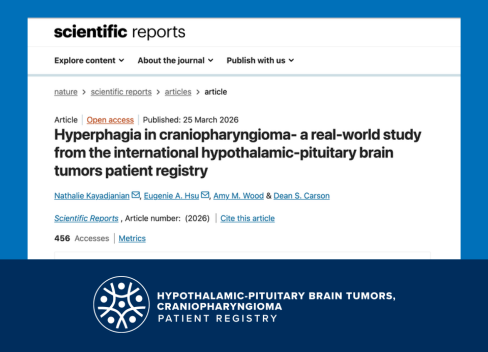
New Study Sheds Light on Hyperphagia in Craniopharyngioma
We’re thrilled to share the publication of our second research study from the Hypothalamic-Pituitary Brain Tumors Patient Registry, led by Raymond A. Wood Foundation. Titled “Hyperphagia in Craniopharyngioma: A Real-World Study: A real-world study from the International Hypothalamic-Pituitary Brain Tumors Patient registry”, it was published in the prestigious Scientific Reports and co-authored by Scientific Director, Nathalie Kayadjanian, Board Members, Eugenie Hsu, Dean Carson, and Executive Director, Amy Wood.
View the Publication
Thanks to our community, we analyzed data from 40 caregivers of craniopharyngioma (CP) survivors. This study helps us better understand hyperphagia—a condition marked by extreme hunger, difficulty feeling full, and persistent food-seeking.
Why this study matters:
Hyperphagia affects more than half of people with CP—and up to 70% of those with hypothalamic obesity (HO), as found in our previous study Understanding the Impact of Craniopharyngioma on Caregivers and Survivors. It can significantly reduce quality of life and place a heavy burden on families.
This study aimed to better understand:
- How eating behaviors differ in those with and without HO
- How hyperphagia presents in CP
- How we can measure and identify hyperphagia
What We Found
Our findings show that eating behaviors in CP range from normal to severe hyperphagia, especially in survivors with HO.
Compared to those without HO, survivors with HO:
- Face additional health challenges linked to hypothalamic dysfunction called hypothalamic syndrome (fatigue, disruption of body clock, emotional, cognitive and behavioral issues)
- Experience more intense hunger and feel less full
- Constantly think about food and consumed by food thoughts
- Have stronger emotional and behavioral responses to hunger
In some cases, caregivers reported behaviors such as eating non-food items (pica), similar to patterns seen in Prader-Willi syndrome.
We found that caregivers of survivors with HO used various strategies to control food environment.
Finally, our results showed that hyperphagia severity scores in CP survivors with HO reach levels comparable to Prader-Willi syndrome, underscoring how serious hyperphagia can be in CP survivors with HO.
A Simple but Powerful Insight
One key takeaway: identifying hyperphagia is tricky due the complexity of the behavior that is not easily observable in a doctor’s office and the stigma associated with eating and food seeking behaviors. Our study showed that simply asking. How much of the day survivors are preoccupied with food thoughts on a scale from 0 to 10 where 0 is none of the time and 10 is all the time (“food preoccupation”) may be a simple and effective way to screen for hyperphagia in clinical settings which could help doctors identify the condition more easily during routine visits.
Why This Changes Patient Care
Hyperphagia is a critical unmet need that is complex and often difficult to diagnose during a brief medical appointment. This study:
- Highlights practical tools to measure hyperphagia
- Helps guide future clinical trials and treatment development
- Supports more accurate diagnosis and better patient care
Ultimately, it brings us closer to treatments that truly address the needs of people living with CP.
View the Publication
Thank You to Our Community
This research was only possible because of caregivers who shared their experiences. Your participation is helping shape the future of CP care.
How You Can Help
If you’re a CP survivor or caregiver, you can make a real impact.
By joining the Hypothalamic-Pituitary Brain Tumors Patient Registry, you:
- Help researchers understand this rare condition
- Contribute to better treatments and care
- Support future families facing CP
Your experience matters—and it sheds light on the real experiences of CP survivors and caregivers towards real solutions. Learn more and enroll in the registry here.
Join the Registry Support Our Work