
In light of the recent FDA approval of setmelanotide for hypothalamic obesity, this commentary offers a personal reflection on what this long-awaited milestone truly means. For those who have endured years without options, it marks a profound shift—from surviving the impossible to finally having hope grounded in science.
by Eugenie Hsu, Ph.D
In 2011, my then 8-year-old son had a 14-hour surgery to resect a giant craniopharyngioma, a rare brain tumor. The surgery was followed by a 6-week hospitalization in the PICU and many months of rehabilitation. We were told he would rely on hormone replacements for the rest of his life. We were also told that about half of craniopharyngioma survivors would have to deal with a much more complex set of symptoms related to a damaged hypothalamus, the tiny structure in the brain that regulates homeostasis.
It quickly became clear that his hypothalamus had been damaged. He had no thirst mechanism, making it extremely difficult to manage his blood sodium because he could not rely on thirst to signal dehydration. Yet where his thirst was absent, his hunger was overpowering. With a relentless appetite, food was all he could think about. He gained weight rapidly despite strict supervision and restrictive diets, and the constant vigilance became unsustainable. We had to lock the kitchen to stop the continual eating. The lack of access led him to steal food, lie about it, and feel deep shame when caught. Normal social life was impossible, and we feared he would never work or be able to be left alone without supervision. Living with hypothalamic obesity (HO) with hyperphagia (unrelenting hunger) felt like hell on earth.
At the time, there was no approved treatment for HO.
But I could not fathom waiting interminably for treatment while I watched HO steal my son’s life away. A powerful catalyst; desperation led me into the scientific literature, searching for any sign of possibility. I began reading about oxytocin, a neuropeptide known for its role in social bonding but also implicated in appetite and metabolic regulation. The hypothalamus produces oxytocin. Damage to the hypothalamus disrupts it. Could replacing or augmenting oxytocin help restore some of what had been lost? In support of this theory, I also learned that oxytocin was being researched as a possible treatment for hyperphagia in Prader Willi syndrome.
With the guidance and supervision of one physician willing to prescribe oxytocin and another willing to serve as a medical consultant, I began an experimental treatment on my son I called “The Oxytocin Experiment.” I documented every step—every observation, every setback, every moment of hope—in a blog that would come to be read around the world: Hope for HO. What began as a personal chronicle became a lifeline for other families who were searching, as we were, for answers in the dark. In 2018, the experiment eventually culminated in my co-authoring a publication of a case study in the Journal of Clinical Endocrinology & Metabolism, contributing a small but meaningful piece of evidence to a problem that desperately needed solutions. Although it was a successful treatment at the time, it was not a permanent fix. But it contributed a small piece of scientific inquiry that would eventually result in more scientific inquiry until at last, there was truly hope for HO.
Now, fifteen years after my son’s diagnosis, something once unimaginable has happened: the U.S. Food and Drug Administration has approved Imcivree® (setmelanotide), the first medication specifically indicated for HO and hyperphagia.
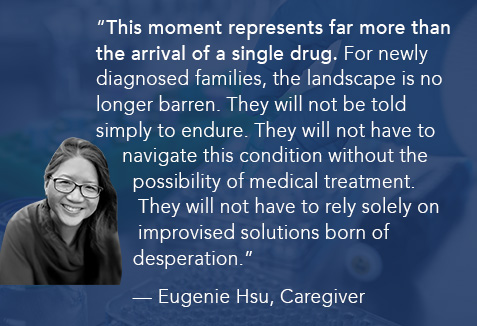
This moment represents far more than the arrival of a single drug. For newly diagnosed families, the landscape is no longer barren. They will not be told simply to endure. They will not have to navigate this condition without the possibility of medical treatment. They will not have to rely solely on improvised solutions born of desperation.
There is still much work to be done. No treatment is a cure. Hypothalamic obesity remains complex, heterogeneous, and deeply challenging. Access must be ensured. Research must continue. Additional therapies must be developed. But the psychological shift—from nothing to something—is profound.
For those of us who lived through the years of nothing, this approval feels like a deep sigh of relief. It honors the families who endured without options. It reflects the courage of survivors who participated in clinical trials. It recognizes the researchers who persisted in studying a rare and difficult condition.
Fifteen years ago when my son was diagnosed, we stood at the edge of an unknown terrain without a map. Today, there is treatment and finally a path forward.
For those of us who lived through the years of nothing, this approval feels like a deep sigh of relief. It honors the families who endured without options. It reflects the courage of survivors who participated in clinical trials. It recognizes the researchers who persisted in studying a rare and difficult condition.
Eugenie Hsu, Ph.D is a licensed psychologist, caregiver to a craniopharyngioma survivor, and and Chairperson of the RAWF board.